
If you are comparing hosting fees in Australia, it is not enough to ask which platform takes the lowest percentage. Airbnb, Booking.com, and Stayz all structure fees differently, and those differences affect your nightly rate, guest conversion, and actual payout.
For Australian hosts, the real question is not just “what is the fee?” It is “who pays it, what is included, what changes by platform setup, and how does it affect the total price a guest sees?” That is especially important now that some states have introduced short-stay levies on top of normal platform costs, and others, including Western Australiam, have introduced mandatory registration requirements that every operating host must meet.
This guide explains how Airbnb, Booking.com, and Stayz fees work in Australia, what compliance obligations now apply across each state, and how to price properly so platform costs do not quietly erode your returns.
Quick Comparison: Airbnb vs Booking.com vs Stayz
| Platform | Common fee model | Typical rate | Best fit |
|---|---|---|---|
| Airbnb | Host-only fee | 15.5% | Broad short-term rental demand across Australia |
| Booking.com | Commission per booking | ~12–15% (varies by contract) | International travel demand and hotel-style booking behaviour |
| Stayz / Vrbo | Pay-per-booking commission | ~8% standard; 12–15% for PMS-connected listings | Family homes, holiday houses, and longer leisure stays |
The key point is that these platforms are not charging the same kind of fee. Even when two channels look similar on paper, the effect on payout and guest-facing pricing can be very different.
Airbnb Fees in Australia
All Australian Hosts Now on a 15.5% Host-Only Fee
As of December 2025, all Australian Airbnb hosts pay a single 15.5% host-only fee deducted from the host payout. Guests see only the price you set — there is no separate Airbnb guest service fee added at checkout.
The rollout happened in stages:
- April 2025 — Hosts using property management or channel management software transitioned first
- August 2025 — New PMS-connected accounts defaulted directly to the 15.5% model
- December 2025 — All remaining hosts transitioned globally, including Australia
The fee applies to the booking subtotal, which includes nightly rates, cleaning fees, pet fees, and other mandatory charges. It does not apply to taxes or security deposits.
What This Means for Pricing
If you were previously on the split-fee model (where hosts paid around 3% and guests paid a separate 14–16.5% Airbnb service fee), the move to 15.5% is a meaningful shift. If you did not adjust your rates after transitioning, your net payout per booking will have dropped significantly.
To maintain the same net payout, your nightly rate needs to increase by approximately 14–16%. Hosts using a PMS or channel manager should apply an Airbnb-specific markup of around 18.34% to preserve earnings without materially changing the total price guests see.
Using a booking subtotal of $420 (including a $300 nightly total and a $120 cleaning fee) as an example:
- Host fee at
15.5%on$420=$65.10 - Estimated host payout before other costs =
$354.90
For more on how to protect margins after fees, see our guide to Airbnb pricing strategies.
Booking.com Fees in Australia
Booking.com works differently. Rather than charging a fixed published rate, Booking.com charges hosts a commission per booking that is set in their individual Accommodation Agreement.
What the Rate Looks Like in Practice
Booking.com does not publish one universal Australian commission percentage. The rate depends on your property type, location, cancellation policy, and participation in any marketing programmes. In Booking.com’s own partner documentation, the company states that the commission percentage is shown at the Agreement step of registration.
That said, the rate most commonly observed in the Australian market falls in the range of 12–15%, with the global average sitting around 15%. Hosts can view their actual contracted rate in the Finance tab of the Booking.com Extranet.
Factors That Can Push the Effective Rate Higher
| Programme | Extra commission | What you get |
|---|---|---|
| Preferred Partner | ~3% extra (total ~18%) | Significantly higher page views and bookings |
| Genius | ~8% extra (total ~23%) | Higher ranking; you fund a guest discount |
| Visibility Booster | Flexible | Temporary ranking boost for selected dates |
| Payments by Booking.com | 1.1–3.1% processing fee | Payment handling and chargeback protection |
Two Practical Consequences
First, be wary of articles that treat Booking.com as though it has one standard Australian rate. Numbers like 12% or 15% reflect what is commonly observed, but they are not a single officially published figure that applies to every host.
Second, a platform can still perform strongly even if the commission is not the lowest. Booking.com attracts a broad international audience and performs well with travellers who prefer hotel-style booking experiences. The right channel is the one that delivers the right bookings at a margin that works for your property.
This is why channel strategy should always be based on net revenue, not fee percentage alone.
Stayz Fees in Australia
Stayz sits within the Vrbo ecosystem and is especially relevant for Australian holiday homes, larger family properties, and leisure-led destinations.
Standard Pay-Per-Booking Setup
For Australian hosts using the standard owner dashboard model, Vrbo’s official help documentation confirms:
- 5% commission charged on the rental amount and any additional fees such as cleaning, pet, and boat fees
- 3% payment processing fee charged on the total amount received from the guest, including taxes and refundable damage deposits (the processing fee on any refunded damage deposit is returned to the host)
- GST is calculated at 10% on the commission and adds 0.5% unless the host has entered a valid GST ID, in which case it is not charged
This brings the effective host-side cost to approximately 8% in the standard setup, before any guest-facing traveller service fee that Vrbo also charges at checkout.
Guest Service Fee
Vrbo also charges travellers a service fee at checkout. This is a percentage of the reservation total and varies depending on the reservation amount. So even when the host-side fee looks modest, the guest may see a higher all-in total than the host’s base rate suggests.
PMS-Managed Listings
Vrbo’s official documentation states that hosts using property management software in regions including Australia may be charged differently. In Australia, PMS-connected listings may be charged 12% to 15%, with the applicable rate shown in the Vrbo dashboard.
This is the same broader pattern seen on Airbnb: the fee model can change significantly depending on whether the host is operating through the native owner dashboard or running a multi-channel setup through software integrations.
Side-by-Side Pricing Example
Assume the following booking:
- Nightly rate total:
$300 - Cleaning fee:
$120 - Booking subtotal before taxes:
$420
| Platform | Fee rate | Fee amount | Host payout (before other costs) |
|---|---|---|---|
| Airbnb | 15.5% | $65.10 | $354.90 |
| Booking.com | 12–15% (contracted) | $50.40–$63.00 | $357.00–$369.60 |
| Stayz (standard) | ~8% (5% + 3%) | $33.60 | $386.40 |
| Stayz (PMS-managed) | 12–15% | $50.40–$63.00 | $357.00–$369.60 |
If the Booking.com commission rate in your agreement is unknown, you do not yet have a reliable margin model. That is why checking your actual Booking.com agreement matters before setting rates or comparing channels.
Additional Costs Australian Hosts Should Not Ignore
Platform fees are only one layer of short-term rental cost. Additional costs may include:
- Cleaning fees and consumables
- Linen and laundry
- Payment handling or banking costs
- Channel manager or PMS subscriptions
- Dynamic pricing tools
- Noise monitoring equipment (see: why Airbnb noise monitors are essential for short-term rental properties)
- Professional management fees
- Damage, maintenance, and restocking allowances
There is also a growing layer of state-based short-stay levies and compliance requirements in Australia that affect your total cost structure.
State-by-State: Short-Stay Levies and Compliance Requirements

Australia has no single national framework for short-term rentals. Rules are set at the state and territory level — and in some cases at the local council level. Here is the current picture for each jurisdiction.
Western Australia — Registration Mandatory, No Levy
Western Australia introduced mandatory STRA registration from 1 January 2025 under the Short-Term Rental Accommodation Act 2024. All hosted and unhosted short-stay properties must be listed on the state-wide STRA Register, regardless of how many nights they operate.
Key requirements for Perth and WA hosts:
- All properties (hosted and unhosted) must register on the WA STRA Register. Registration costs $250 initially and $100 per annual renewal
- From 1 January 2026, unhosted properties in the Perth metropolitan area that operate for more than 90 nights per year must also hold development approval from the local council. Properties within the 90-night threshold can operate without approval, but must still be registered
- Hosted properties — where the owner lives on-site during guest stays — are exempt from the development approval requirement statewide
- Failure to register can result in fines of up to $20,000, and unregistered properties cannot legally be advertised or accept bookings
- There is no state tourist levy in WA — unlike Victoria and the ACT, Western Australia does not currently apply a percentage-based levy on bookings
For Perth property owners specifically, the 90-night development approval threshold is the most operationally significant requirement. If you intend to operate an unhosted property for more than 90 nights in 2026, council development approval should already be in place or in progress.
Victoria — 7.5% Short Stay Levy
Victoria’s short stay levy applies from 1 January 2025 to stays of less than 28 consecutive days. The levy is 7.5% of the total booking fees paid, including cleaning fees and GST where applicable (but not credit card fees). The levy does not apply to a host’s principal place of residence. Booking platforms collect and remit the levy on behalf of hosts.
From 2025, owners corporations (strata bodies) also have expanded powers to ban short-stay accommodation in their buildings via a 75% special resolution vote. This cannot apply to principal place of residence hosts.
ACT — 5% Short-Term Rental Accommodation Levy
In the ACT, the short-term rental accommodation levy applies to bookings made from 1 July 2025. It is 5% of the total booking amount paid by the guest and applies to bookings of not more than 28 continuous days.
New South Wales — Mandatory Registration and Night Caps
NSW operates a mandatory STRA Register with registration fees ($65 initial, $25 annual renewal). All short-term rental properties must display their registration number on listings.
Key rules for NSW hosts:
- Non-hosted properties in Greater Sydney are capped at 180 nights per year
- Byron Shire has a stricter cap of 60 nights per year for non-hosted properties (from September 2024)
- Hosted properties (owner lives on-site) have no night cap
- Properties must meet fire safety standards, including interconnected smoke alarms, and comply with the STRA Code of Conduct
- Non-compliance penalties can reach $11,000
There is no statewide tourist levy in NSW.
Queensland — Local Council Rules, No State Levy
Queensland has no statewide STRA register or tourist levy. Rules are set at the local council level and vary significantly by area.
Key points for Queensland hosts:
- Brisbane is progressing a new permit system, proposed to commence from 1 July 2026 pending state government approval. Hosts will likely need a council-issued permit and must nominate a 24/7 contact person
- Noosa already operates one of Queensland’s most comprehensive local registration systems, with mandatory registration and active enforcement
- Gold Coast and Sunshine Coast have local planning requirements, with development approval potentially required depending on zoning
- There is no statewide night cap, though individual councils may apply local restrictions
- Penalties for non-compliance with local rules can reach approximately $8,345 (50 penalty units at 2025–26 rates)
South Australia, Tasmania, and Northern Territory
These states and territories do not have statewide STRA registers or tourist levies. Requirements are managed through local council planning schemes and vary by area. Hosts should check their local government authority for specific obligations.
Which Platform Suits Which Host?
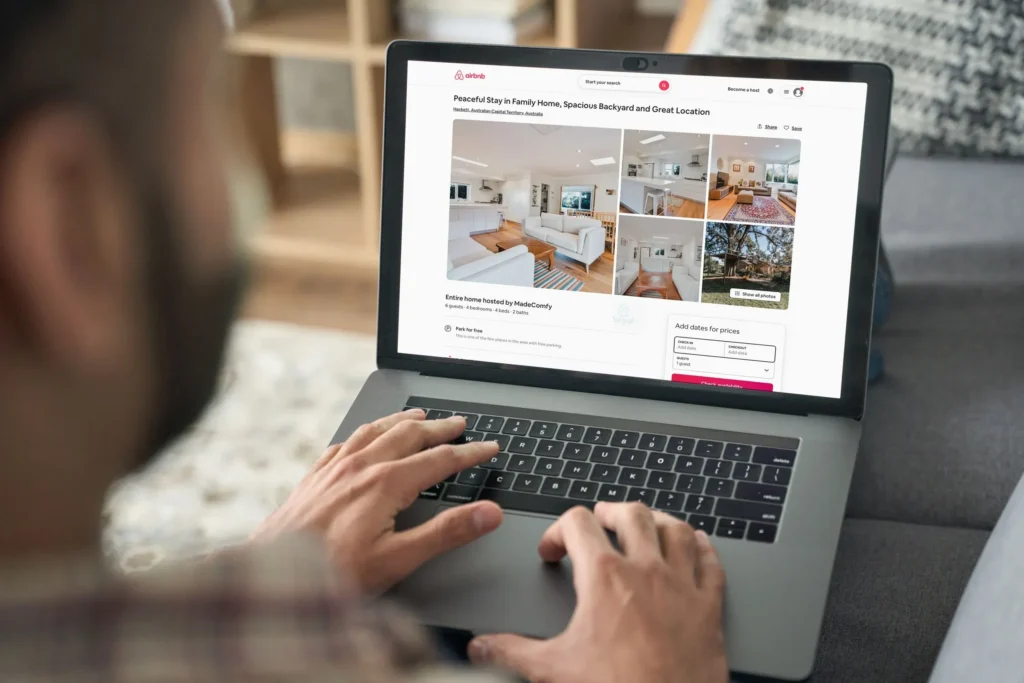
No single platform is best for every property.
Airbnb is often strongest when:
- The property suits mainstream short-term rental demand
- Review volume and platform visibility matter
- You want broad demand across metro and suburban markets
- You are competing against other home-style accommodation rather than hotels
Booking.com is often strongest when:
- The property attracts international guests
- You want access to hotel-style booking behaviour
- Your operations can meet more hotel-like guest expectations
Stayz is often strongest when:
- The property is a larger family home or holiday house
- The destination attracts leisure travel and group stays
- Guests are booking for school holidays, weekends away, or regional breaks
- Longer average stays improve profitability
On any platform, a well-set-up and guest-ready property is the foundation for strong reviews and competitive occupancy. Our short-term rental features and amenities checklist covers what Australian guests expect from a quality listing.
In practice, many high-performing properties do best with a multi-channel approach. That creates more exposure, but it also means more pricing complexity, more calendar management, and more care with fee markups across channels.
That challenge is one reason professional operators invest in channel management and structured revenue strategy. We cover that operational side in 7 key challenges of short-term rental property management.
The Right Question Is Not “Which Platform Is Cheapest?”
Hosts often start by asking which platform charges the least. That is understandable, but it is not the right final question.
The better questions are:
- Which platform brings the right guests for this property?
- Which channel converts best at my true all-in price?
- Which fee structure applies to my actual setup?
- What does the booking look like after platform costs, levies, cleaning, and operations?
A cheaper channel that delivers weaker demand, lower-quality bookings, or more vacant nights can still be the worse financial outcome.
If you are weighing those trade-offs more broadly, our guide to short-term vs long-term rental strategy covers how fee structures fit into overall property performance.
Why Many Owners Choose Professional Management
Managing platform fees, state compliance, registration deadlines, pricing across multiple channels, guest communication, cleaning coordination, and maintenance is not passive income. For most property owners, it is a second job — and an increasingly complex one as state regulations evolve.
This is where working with a professional management company like Sepal Stays makes a material difference. Rather than handling every moving part yourself, you hand your property to a team that manages the full picture on your behalf:
- Multi-channel distribution across Airbnb, Booking.com, and Stayz, with pricing and markups calibrated for each platform’s fee structure
- Dynamic pricing that responds to local demand, seasonal patterns, and competitor rates — so your property earns what the market will support, not just what you guessed
- Compliance management including WA STRA registration, state levy obligations, and keeping your listing current with evolving requirements
- Guest communication and screening, handling everything from enquiries through to check-out — including how to handle difficult guest situations — so you are not tethered to your phone
- In-house cleaning, linen, and property maintenance coordinated between every stay
The result is a property that works harder for you, with less effort on your part and fewer gaps in the calendar. If you are considering whether professional management makes sense for your Perth or WA property, read more about our approach to Airbnb management in Perth.
Conclusion
Airbnb, Booking.com, and Stayz do not charge hosts in the same way, and that distinction matters.
In Australia, Airbnb now charges all hosts a single 15.5% host-only fee, with the transition completed in December 2025. Booking.com uses a commission model where the contracted rate is not published as a universal figure, but the range most commonly observed in Australia is 12–15%. Stayz / Vrbo costs approximately 8% in the standard owner dashboard model (5% commission plus 3% payment processing), but PMS-connected listings in Australia may be charged 12–15% — hosts should use the rate shown in the Vrbo dashboard rather than assuming the standard owner rate applies.
On the compliance side, Western Australia now requires all short-stay properties to be registered, with development approval required for unhosted Perth properties exceeding 90 nights per year. Victoria and the ACT apply booking levies. NSW maintains mandatory registration and night caps. Queensland is moving towards a permit system in Brisbane from mid-2026.
For Australian hosts, the safest approach is to price based on the actual fee structure that applies to your listing, account for operating costs and state-based levies on top, and stay current with the compliance requirements in your state.
Frequently Asked Questions
How much does Airbnb charge hosts in Australia?
As of December 2025, all Australian Airbnb hosts pay a single 15.5% host-only fee on the booking subtotal. This is deducted from the host payout before you receive it. Guests are not charged a separate Airbnb service fee.
What is the Booking.com commission rate in Australia?
Booking.com does not publish a single universal Australian rate. The commission is shown in your Accommodation Agreement and depends on your property type, location, and cancellation policy. The range most commonly observed in the Australian market is 12–15%, with the global average around 15%.
Is Stayz cheaper than Airbnb for Australian hosts?
In the standard pay-per-booking setup, yes. The host-side cost is approximately 8% (5% commission plus 3% payment processing), which is meaningfully lower than Airbnb’s 15.5%. However, hosts using property management software may be charged 12–15% under Vrbo’s integrated listing model. Always check the rate shown in your Vrbo dashboard.
Do hosting fees include Victoria or ACT short-stay levies?
No. Those levies are separate government charges, not platform commissions. But they still affect the total price a guest pays and should be considered in your pricing strategy.
Do WA hosts need to register their short-stay property?
Yes. All Western Australian short-stay properties, both hosted and unhosted, must be registered on the state STRA Register. From 1 January 2025, operating an unregistered property is prohibited and can attract fines of up to $20,000. Unhosted properties in the Perth metropolitan area that operate for more than 90 nights per year must also hold development approval from their local council.
Should I list on one platform or several?
For many properties, listing on several platforms will produce better exposure and occupancy. But multi-channel distribution also increases pricing complexity, guest management load, and the need for proper calendar sync and channel-specific rate strategy.